
Parametric Distribution Fitting and Extreme Value Inference for Rainfall in Maiduguri
DOI:
https://doi.org/10.70882/josrar.2025.v2i6.143Keywords:
Extreme Value Theory (EVT), Rainfall Modelling, Gamma Distribution, Probability Distribution Fitting, Gumbel Distribution, Flood Risk Assessment, Return Level EstimationAbstract
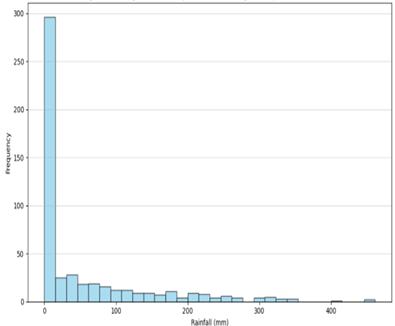
The paper takes a stringent approach of statistical characterization and existence of extreme values of monthly rainfall in Maiduguri capital city of Borno State, Nigeria and applies a 4-decade dataset (1981-2023). Descriptive statistics show that there is a highly skewed, discontinuous rainfall regimen as indicated by the wide gap between the value of mean (53.86 mm) and the median (1.60 mm). As this aims to determine the best probabilistic model that describes the non-zero monthly rainfall, Gamma, Weibull, and Lognormal distributions were both fit using Maximum Likelihood Estimation (MLE) and compared using Akaike (AIC) and Bayesian (BIC) Information Criteria. The Gamma distribution proved to be the best model to choose since it gave the smallest AIC (3007.99) and BIC (3018.78) values and its estimation value was strong though in the lower and middle quantile ranges. To select the Gumbel distribution (as opposed to the Generalized Extreme Value (GEV) distribution) to model annual maxima, the shape parameter closes to zero and the principle of parsimony were used. The estimation of the level at returns describes the large flood events indicating a 469.44 mm and 516.21 mm of the significant floods 50-year and 100-year returns respectively. The results offer crucially designed site values critical to improving the urban drainage-related infrastructure and flood resilience mechanisms of the semi-arid Sudano-Sahelian region.
References
Abdullah, M. A., Youssef, A. M., Nashar, F., & AlFadail, E. A. (2019). Statistical analysis of rainfall patterns in Jeddah City, KSA: future impacts. Rainfall-Extrem. Distrib. Prop, 1-17.
Ilesanmi, A. O., Halid, O. Y., Adejuwon, S. O., Odukoya, E. A., & Olayemi, M. S. (2024). Application of generalized extreme value distribution to annual maximum rainfall. FUDMA JOURNAL OF SCIENCES, 8(2), 118-122 https://doi.org/10.33003/fjs-2024-0802-2268
Jain, S., Gautam, S. S., & Rathore, N. R. (2025). Statistical modelling and best-fit distribution analysis of annual rainfall in the Bundelkhand Region, Madhya Pradesh, India. International Journal of Environment and Climate Change, 15(9), 380–401.
Kane, I. L., Tahir, K. U., & Rabe, A. (2023). Extreme rainfall modeling through the lens of extreme value theory: A case study of Katsina City, Nigeria. UMYU Scientifica, 2(3), 118–127. https://doi.org/10.56919/usci.2323.015
Louzaoui, A., Azzat, M. H., & El Arrouchi, M. (2023). Prediction of future rainfall record through the modeling of extreme value theory: A case study of Melk Zhar in the Souss Massa region of Morocco. Advances and Applications in Statistics, 86(2), 229–241. https://doi.org/10.17654/0972361723024
Montes-Pajuelo, R., Rodríguez-Pérez, Á. M., López, R., & Rodríguez, C. A. (2024). Analysis of probability distributions for modelling extreme rainfall events and detecting climate change: Insights from mathematical and statistical methods. Mathematics, 12(7), 1093. https://doi.org/10.3390/math12071093
Nerantzaki, S. D., & Papalexiou, S. M. (2022). Assessing extremes in hydroclimatology: A review on probabilistic methods. Journal of Hydrology, 605, 127302. https://doi.org/10.1016/j.jhydrol.2021.127302
Nwaigwe, C. C., Ogbonna, C. J., & Achem, O. (2023). Statistical modeling of rainfall distribution in Jos, Plateau State, Nigeria. Asian Journal of Probability and Statistics, 22(1), 46–55.
Serinaldi, F. (2009). A multisite daily rainfall generator driven by bivariate copula‐based mixed distributions. Journal of Geophysical Research: Atmospheres, 114(D10). https://doi.org/10.1029/2008JD011258
Serinaldi, F., & Kilsby, C. G. (2015). Stationarity is undead: Uncertainty dominates the distribution of extremes. Advances in Water Resources, 77, 17-36 https://doi.org/10.1016/j.advwatres.2014.12.013
Downloads
Published
Issue
Section
License
Copyright (c) 2025 Journal of Science Research and Reviews

This work is licensed under a Creative Commons Attribution-NonCommercial 4.0 International License.
- Attribution — You must give appropriate credit, provide a link to the license, and indicate if changes were made. You may do so in any reasonable manner, but not in any way that suggests the licensor endorses you or your use.
- NonCommercial — You may not use the material for commercial purposes.
- No additional restrictions — You may not apply legal terms or technological measures that legally restrict others from doing anything the license permits.