
Foraminiferal Biostratigraphy and Paleoenvironment of Ovia-1 Well, Northern Depobelt of Niger Delta Basin, Nigeria
DOI:
https://doi.org/10.70882/josrar.2025.v2i5.128Keywords:
Age determination, Biozonation, Paleodepositional environmentAbstract
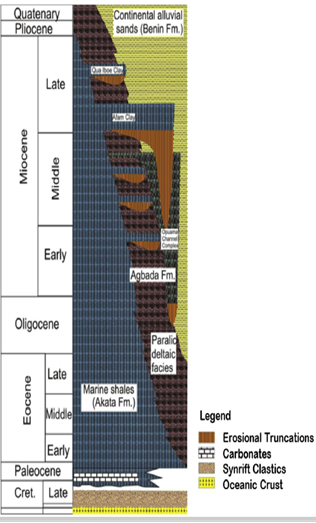
The Ovia-1 well located in the Northern Depobelt, Niger Delta Basin was investigated based on Gamma Ray log, Lithostratigraphy, foraminifera and nanno fossil biostratigraphy. This is aimed to determine biostratigraphic distribution, age and paleodepositional environment of the studied intervals. Based on the foraminfera, the marker species identified are Quinqueloculina microcostata, Amphistegina lessonii, Heterostegina sp, Lenticulina inornata, ex gr. costiferum, Heterolepa pseudoungeriana, Hanzawaia stratoni, Spirosigmoilina oligocaenica, and Cibicorbis inflata. Twelve (12) biozones identified are N15 – N14 (middle Miocene middle Miocene 12.26 – 13.12Ma), ( N13 – N12/N11 middle Miocene 13.12 – 13.68Ma ) N9 – N10/N11 middle Miocene 14.20 – 15.6Ma) ( N4 - P22 early Miocene 20.94 –23.2Ma ) ( P17-P18 early Oligocene 33.0 – 36.50Ma ) ( P14 middle Eocene 36.50 – 43.2Ma ) P12 middle Eocene 41.0 – 43.2Ma ) ( P4 late Paleocene 56.8 – 57.3Ma) ( P1 – M18 early Paleocene 64.6 – 65.0Ma respectively ). The paleoecological interpretation, based on the identified plantic foraminiferal species, indicates Inner Neritic to Outer Neritic zones. Lithostratigraphic criteria including Gamma Ray log responses and sand/shale ratios supported by paleobathymetric data indicate that the Ovia-1 have well, have two broad lithofacies units -the Marine Paralic and the Marine Units, which are ascribed to the Agbada Formation, Lithological analysis revealed alternating layers of shale, and sand, reflecting different paleoenvironmental conditions during deposition. The age of the well was established as Middle to Late Miocene, based on the bioevents of key marker species. Additionally, the limited presence of calcareous benthic and planktonic foraminifera supports the interpretation of a shallow marine depositional setting.
References
Avbovbo, A. A. (1978). Tertiary lithostratigraphy of the Niger Delta. AAPG Bulletin, 62(2), 295–300. https://doi.org/10.1306/C1EA47C4-16C9-11D7-8645000102C1865D
Berggren, W. A., Kent, D. V., Swisher, C. C., & Aubry, M.-P. (1995). A revised Cenozoic geochronology and chronostratigraphy. In W. A. Berggren, D. V. Kent, M.-P. Aubry, & J. Hardenbol (Eds.), Geochronology, time scales and global stratigraphic correlation (SEPM Special Publication 54, pp. 129–212).
Berger, W. H., & Miller, K. G. (1988). The last 500,000 years: Glacial/interglacial cycles and planktonic foraminiferal biostratigraphy. Marine Micropaleontology, 13(1), 1–36. https://doi.org/10.1016/0377-8398(88)90003
Blow, W. H. (1969). Late Middle Eocene to Recent planktonic foraminiferal biostratigraphy. In P. Brönnimann & H. H. Renz (Eds.), Proceedings of the First International Conference on Planktonic Microfossils, Geneva, 1967, Vol. 1 (pp. 199–422). Leiden: E. J. Brill.
Blow, W. H. (1979). The Cainozoic Globigerinida: A study of the morphology, taxonomy, evolutionary relationships and the stratigraphical distribution of some Globigerinida (mainly Globigerinacea). Leiden: E. J. Brill.
Corredor, F., Shaw, J. H., & Bilotti, F. (2005). Structural styles in the deep-water fold and thrust belts of the Niger Delta. AAPG Bulletin, 89(6), 753–780.
Doust, H., & Omatsola, E. (1990). Niger Delta. In J. D. Edwards & P. A. Santogrossi (Eds.), Divergent/Passive Margin Basins (AAPG Memoir 48, pp. 201–238).
Ebong, E. D., Okosun, E. A., & Essien, N. U. (2007). Stratigraphy and depositional environments of the Eocene strata in the eastern Niger Delta, Nigeria. Global Journal of Geological Sciences, 5(2), 107–114.
Evamy, B. D., Haremboure, J., Kamerling, P., Knaap, W. A., Molloy, F. A., & Rowlands, P. H. (1978). Hydrocarbon habitat of Tertiary Niger Delta. AAPG Bulletin, 62(1), 1–39.
Hedberg, H. D. (1976). International stratigraphic guide: A guide to stratigraphic classification, terminology, and procedure. New York: John Wiley & Sons.
Lehner, P., & De Ruiter, P. A. C. (1977). Structural history of Atlantic margin of Africa. In A. E. M. Nairn, W. H. Kanes, & F. G. Stehli (Eds.), The Ocean Basins and Margins, Volume 1: The South Atlantic (pp. 223–276). New York: Plenum Press.
Martini, E. (1971). Standard Tertiary and Quaternary planktonic foraminiferal zonation. In P. Brönnimann & H. H. Renz (Eds.), Proceedings of the First International Conference on Planktonic Microfossils, Geneva, 1967, Vol. 2 (pp. 739–785). Leiden: E. J. Brill.
Short, K. C., & Stauble, A. J. (1965). Outline of geology of Niger Delta. AAPG Bulletin, 51(5), 761–779.
Tuttle, M. L. W., Charpentier, R. R., & Brownfield, M. E. (1999). The Niger Delta Petroleum System: Niger Delta Province, Nigeria, Cameroon, and Equatorial Guinea, Africa. U.S. Geological Survey Open-File Report 99-50-H.
Wu, S., & Bally, A. W. (2000). Slope tectonics: Comparisons and contrasts of structural styles of salt and shale tectonics of the northern Gulf of Mexico with shale tectonics of offshore Nigeria in the Gulf of Guinea. In W. Mohriak & M. Talwani (Eds.), Geophysical Monograph 115: Atlantic Rifts and Continental Margins (pp. 151–172). American Geophysical Union.
Downloads
Published
Issue
Section
License
Copyright (c) 2025 Journal of Science Research and Reviews

This work is licensed under a Creative Commons Attribution-NonCommercial 4.0 International License.
- Attribution — You must give appropriate credit, provide a link to the license, and indicate if changes were made. You may do so in any reasonable manner, but not in any way that suggests the licensor endorses you or your use.
- NonCommercial — You may not use the material for commercial purposes.
- No additional restrictions — You may not apply legal terms or technological measures that legally restrict others from doing anything the license permits.