
Assessment of Bacterial and Fungal Contaminants from Some Restaurants Wastewater in Karji, Chikun Local Government Area, Kaduna State, Nigeria
DOI:
https://doi.org/10.70882/josrar.2025.v2i5.111Keywords:
Bacteria, Fungi, Restaurant, WastewaterAbstract
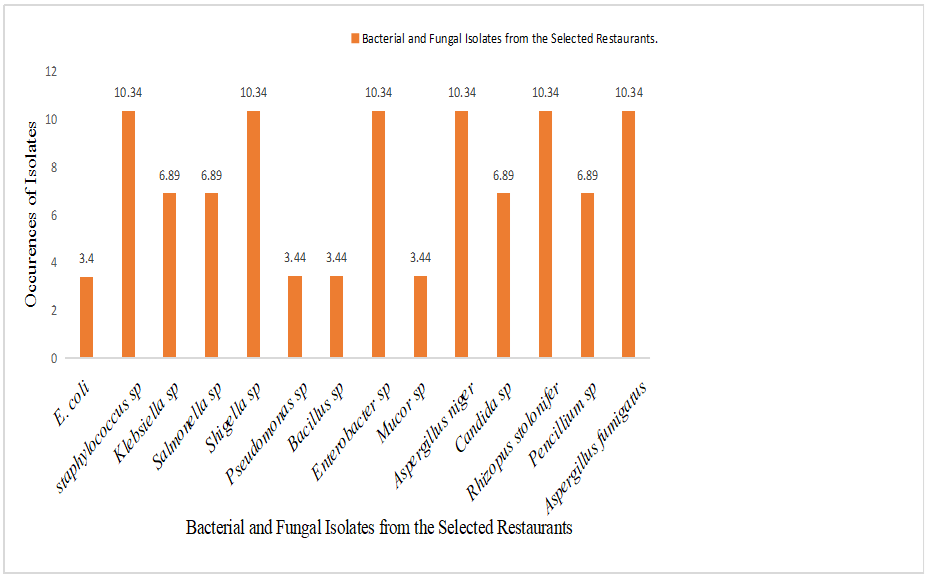
The relevance of restaurants in a society can never be overemphasized. However, improper management of waste water being generated by these restaurants poses a great deal of health risks by the interacting pathogenic microorganisms from the waste water with man. This study investigated the presence and diversity of bacteria and fungi in wastewater from selected restaurants at Karji Chikun Local Government Area, Kaduna State. Wastewater samples were collected from 3 restaurants in duplicate and analyzed for bacterial and fungal contaminants using standard microbiological methods. The results showed that all wastewater samples contained high levels of bacterial and fungal contaminants, including pathogenic species. Eight bacterial species (E. coli, Klebsiella pneumoniae, Bacillus sp, Salmonella sp, Enterobacter sp, Shigella sp, Staphylococcus sp, and Pseudomonas sp) accounted for 8 (55.12%) while Six fungal isolate (Mucor sp, Aspergillus fumigatus, Aspergillus niger, Candida sp, Rhizopus stolonifer and Penicillium sp) accounted for 6 (44.88%). The most common bacterial isolates were Escherichia coli, Salmonella sp., Pseudomonas sp., Klebsiella pneumoniae, Bacillus sp., Enterobacter sp., Shigella sp., and Staphylococcus sp, while the dominant fungal species were Aspergillus fumigatus, Penicillium spp., Candida spp., Rhizopus stolonifer, Aspergillus niger, and Mucor sp. The study highlights the need for effective wastewater management practices in restaurants to prevent environmental pollution and protect public health. The findings of this study can inform policy decisions and wastewater management strategies in Karji and similar settings. The research recommends regular monitoring of restaurant wastewater, implementation of proper wastewater treatment systems, and education and training programs for restaurant staff on wastewater management and best hygiene practices.
References
Absar, A.K. (2005). Water and Wastewater Properties and Characteristics. In water Encyclopedia: Domestic, Municipal and Industrial Water Supply and Waste Disposal. Lehr, J.H., & Keeley, J. (Eds). John Wiley and Sons, Inc., New Jersey, pp. 903 900. https://www.wiley.com/en-us/Water+Encyclopedia-p-9780471726086
Adams, M. R., & Moss, M. O. (2009). Food Microbiology (4th ed., pp. 188 206). New Delhi: New Age International. https://books.google.com/books/about/Food_Microbiology.html?id=BZNKI088iooC
Adewoye, S. O. (2010). Effect of different effluent discharge on the aspect of water quality of ASA River, Ilorin, Nigeria. Agriculture and Biological Journal of North America, 1(4), 731 736. https://www.scihub.org/ABJNA/PDF/2010/4/1-4-731-736.pdf
Ahmed, M. F., & Rahman, M. M. (2000). Water supply and sanitation. Dhaka, Bangladesh: ITN-Bangladesh, BUET. https://www.buet.ac.bd
Akpor, O. B., & Muchie, M. (2011). Environmental and public health implications of wastewater quality. African Journal of Biotechnology, 10(13), 2379 2387. https://www.ajol.info/index.php/ajb/article/download/93165/82578
Akpor, O. B., Momba, M. N. B., & Okonkwo, J. O. (2008). The effect of pH and temperature on phosphate and nitrate uptake by wastewater protozoa. African Journal of Biotechnology, 7(13), 2221 2226. https://academicjournals.org/journal/AJB/article-full-text-pdf/7779A8D6558.pdf
Aktar, Z., Fakhruddin, A. N. M., Ahmed, M. S. U., Nasreen, T., & Parveen, S. (2009). Assessment and treatment of the supplied pipeline water of selected areas of Dhaka City. Bangladesh Journal of Scientific and Industrial Research, 44(3), 335 340. https://www.researchgate.net/publication/240807971_Assessment_and_Treatment_ofthe_Supplied_Pipeline_Water_of_Selected_Areas_of_Dhaka_City
Alam, R., Alam, J. B., Hasan, M. M., Das, S. R., Rahman, K., & Banik, B. K. (2006). Study of water quality of Sylhet City and its restaurants: health associated risk assessment. Iranian Journal of Environmental Health Science & Engineering, 3(1), 9 18. https://ijee.shirazu.ac.ir/article_103_103.html
Alghobar, M. A., Ramachandra, L., & Suresha, S. (2018). Effect of sewage water irrigation on soil properties and evaluation of the accumulation of elements in Grass crop in Mysore city, Karnataka, India. American Journal of Environmental Protection, 3, 283–291. https://www.sciencepublishinggroup.com/journal/paperinfo?journalid=130&doi=10.11648/j.ajep.20180306.15
Aluyi, A. S. A., Ekhaise, O. F., & Adelusi, M. (2006). Effect of human activities and oil pollution on the microbiological and physiochemical quality of Udu River, Warri, Nigeria. Journal of Applied Sciences, 6(5), 1214 1219. https://scialert.net/fulltext/?doi=jas.2006.1214.1219
American Public Health Association (APHA). (2005). Standard Methods for the Examination of Water and Wastewater (21st ed.). Washington, DC: APHA. https://www.standardmethods.org/
Amna, A., & Fozia, N. (2017). Frequency distribution of bacteria isolated from different industrial effluents. Daffodil International University Journal of Science and Technology, 7(1), 123 129. https://journals.du.ac.bd/index.php/DIUJST/article/view/129
APHA. (1998). Standard Methods for Examination of Water and Wastewater (20th ed.). USA: American Public Health Association. https://www.standardmethods.org/
Bain, R., Cronk, R., Wright, J., Yang, H., & Bartram, J. (2014b). Fecal contamination of drinking water in developing countries: a systematic review and meta-analysis. PLoS Medicine, 11, e1001644. https://journals.plos.org/plosmedicine/article?id=10.1371/journal.pmed.1001644
Bolong, N., Ismail, A. F., Salim, M. R., & Matsuura, T. (2019). A review of the effects of emerging contaminants in wastewater and options for their removal. Desalination, 239, 229–246. https://doi.org/10.1016/j.desal.2008.03.020
Buckalew, D. W., Hartman, L. J., Grimsely, G. A., Martin, A. E., & Register, K. M. (2006). A long-term study comparing membrane filtration with colilert defined substrate in detecting faecal coliform and Escherichia coli in natural water. Journal of Environmental Management, 80, 191 197. https://doi.org/10.1016/j.jenvman.2005.09.006
Cappuccino, G. J., & Sherman, N. (1999). Microbiology: A Laboratory Manual; Biochemical Activities of Microorganisms (5th ed., pp. 133 187). California: Benjamin/Cummings Science Publishing. https://www.pearson.com/store/p/microbiology-a-laboratory-manual/P100000256805
Ejorwokeoghene, J. O. (2024). Wastewater Management in Africa: Challenges and Recommendations. Environmental Health Insight, 18, 11 786. https://doi.org/10.1177/11786302241289681
Ganguli, P., Kumar, D., & Ganguly, A. R. (2017). US power production at risk from water stress in a changing climate. Scientific Reports, 7(1), 1–13. https://doi.org/10.1038/s41598-017-06021-3
Gwimbi, P. (2011). The microbial quality of drinking water in Manonyane community: Maseru District (Lesotho). African Health Sciences, 11(3), 474 480. https://www.ajol.info/index.php/ahs/article/view/67164
Imran, A., Norhayati, A., Iwamoto, K., Ali, Y., Shaza, E. M., Pau, L. S., Wai, Y. C., & Kuan, S. K. (2022). The role of restaurant wastewater for producing bioenergy towards a circular bioeconomy: A review on composition, environmental impacts and sustainable integrated management. Journal of Environmental Resources, 214, 11 3854. https://doi.org/10.1016/j.jenvres.2022.114854
Kanu, I., & Achi, O. K. (2017). Industrial effluents and their impact on water quality of receiving rivers in Nigeria. Journal of Applied Technology in Environmental Sanitation, 1(1), 75 86. https://doi.org/10.5937/jates1701075K
König, M., Escher, B. I., Neale, P. A., Krauss, M., Hilscherová, K., & Novák, J. (2017). Impact of untreated wastewater on a major European river evaluated with a combination of in vitro bioassays and chemical analysis. Environmental Pollution, 12. https://doi.org/10.1016/j.envpol.2017.05.042
Lahlou, Z. M. (2002). Water quality in distribution systems. National Drinking Water Clearing House Fact Sheet. West Virginia University, pp. 1 4. https://www.nesc.wvu.edu/resources/library/tech-pubs/water-quality-in-distribution-systems
Sauer, C. J., Tünger, S., & Schwartz, T. (2017). Microbial contamination of wastewater from restaurants in Germany. Journal of Applied Microbiology, 123(4), 931 941. https://doi.org/10.1111/jam.13555
Schwabe, K., Nemati, M., Amin, R., Tran, Q., & Jassby, D. (2020). Unintended consequences of water conservation on the use of treated municipal wastewater. Nature Sustainability, 3, 628 635. https://doi.org/10.1038/s41893-020-0529-2
Scott, C. A., Drechsel, P., Raschid-Sally, L., Bahri, A., Mara, D., & Redwood, M. (2019). Wastewater irrigation and health: Challenges and outlook for mitigating risks in low-income countries. In P. Drechsel et al. (Eds.), Wastewater Irrigation and Health (pp. 381 394). London: Earthscan / IDRC / IWMI. https://ageconsearch.umn.edu/record/127725
Sulieman, M. H., Yousif, W. M., & Mustafa, A. M. (2010). Chemical, Physicochemical and physical properties of wastewater from the Sudanese fermentation industry (SFI). Fourteenth International Water Technology Conference, IWTC Cairo, Egypt, pp. 305 315. https://www.iwtc.info/2010conference-proceedings
Sunday, E. O. (2023). Assessment of water quality index and some Enteric Bacteria characteristics of Ossiom. Cognizance Journal of Multi-Disciplinary Studies (CJMS). https://www.cjmsjournal.org/articles/assessment-water-quality-ossiom
Techobanoglous, G., Burton, F. L., & Stensel, H. D. (2003). Wastewater Engineering: Treatment, Disposal and Reuse (4th ed., pp. 12 23). Delhi, India: Tata McGraw Hill Publishing. https://www.mheducation.com/highered/product/wastewater-engineering-treatment-
Templeton, M. R., Graham, N., & Voulvoulis, N. (2019). Emerging chemical contaminants in water and wastewater. Philosophical Transactions of the Royal Society A, 367, 3873–3875. https://doi.org/10.1098/rsta.2009.018
Tortajada, C. (2020). Contributions of recycled wastewater to clean water and sanitation Sustainable Development Goals. NPJ Clean Water, 3(1), 1–6. https://doi.org/10.1038/s41545-020-0066-5
Zuthi, M. F. R., Biswas, M., & Bahar, M. N. (2009). Assessment of supply water quality in the Chittagong City of Bangladesh. ARPN Journal of Engineering and Applied Sciences, 4, 73 80. http://www.arpnjournals.com/jeas/research_papers/rp_2009/jeas_0509_188.pdf
Downloads
Published
Issue
Section
License
Copyright (c) 2025 Journal of Science Research and Reviews

This work is licensed under a Creative Commons Attribution-NonCommercial 4.0 International License.
- Attribution — You must give appropriate credit, provide a link to the license, and indicate if changes were made. You may do so in any reasonable manner, but not in any way that suggests the licensor endorses you or your use.
- NonCommercial — You may not use the material for commercial purposes.
- No additional restrictions — You may not apply legal terms or technological measures that legally restrict others from doing anything the license permits.