
Antimicrobial Potential of the Yellow Plum (Ximenia americana): A Qualitative Evaluation of Ethyl Acetate Extracts from the Various Plants’ Parts
DOI:
https://doi.org/10.70882/josrar.2025.v2i5.110Keywords:
Extracts, Harness, Inhibition, Potential, Susceptibility, BioactiveAbstract
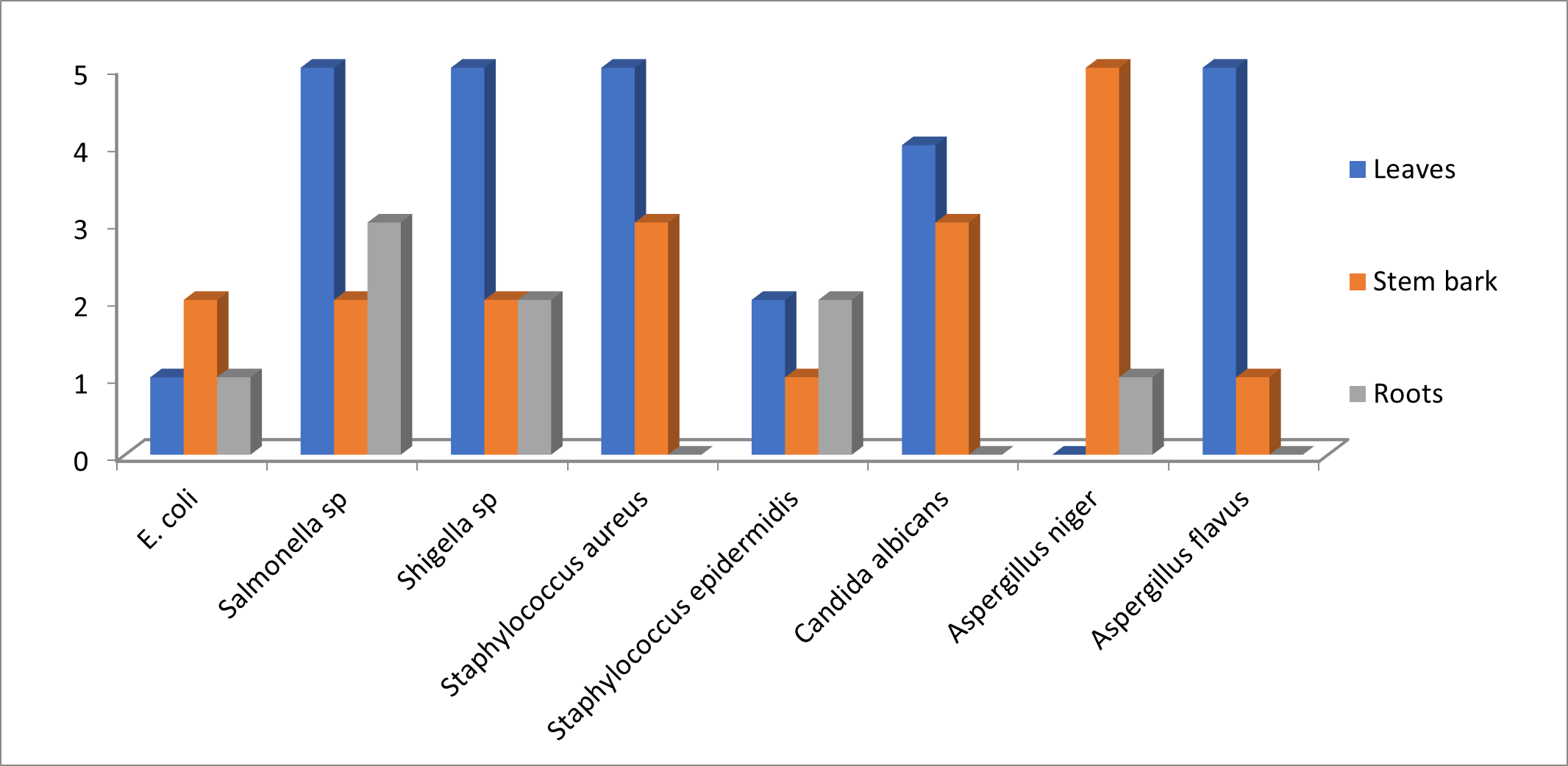
Medicinal plants have long been traditionally used as remedies for various ailments which include antimicrobials. Ximenia americana which belongs to the Olacaceae family is one of the plants used in traditional medicine in Africa. This study was targeted at assessing qualitatively, the antimicrobial potential of the ethyl acetate extracts from the roots, stem bark and leaves of the plant at different concentrations on selected environmental and clinical samples of bacterial and fungal pathogens using standard susceptibility test procedures. Extracts from the roots, stem bark and leaves of the plant revealed the presence of some phytochemicals ranging from glycosides (saponins and flavonoids), polyphenolics (tannins and steroids) to alkaloids. Alkaloids, flavonoids and steroids were found to be present in the same intensity in all parts while the leaves contained alkaloids, tannins, flavonoids steroids and steroids at varying intensities. The highest susceptibility was recorded from the leaf extracts where three of the test bacterial pathogens (Salmonella sp, Shigella sp and Staphylococcus aureus) showed varying degrees of susceptibilities at 20mg/ml, 25mg/ml, 30mg/ml, 35mg/ml and 40mg/ml. Furthermore, Staphylococcus aureus within this category exhibited the highest zone of inhibition (ZI) of 12mm indicating an increase in the disc size of 8mm conforming with Gentamycin (10µg) and Erythromycin (10µg) used as controls from commercially available antibiotic multi disks with ZIs of S (12mm). This study further reveals that the root extracts of the plant had no inhibitory effects on Aspergillus niger, Aspergillus flavus and Candida albicans at concentrations of 20mg/ml. 25mg/ml, 30mg/ml, 35mg/ml and 40mg/m. This finding potentially reveals the suitability of X. americana plant to be harnessed for its antibacterial potential through a further quantitative, safe and efficient evaluation of the specific bioactive components of the plant parts responsible for each antimicrobial activity as indicated in this study.
References
Aguilera-Correa, J. J., Esteban, J., & Vallet-Regí, M. (2021). Inorganic and polymeric nanoparticles for human viral and bacterial infections prevention and treatment. Nanomaterials, 11(1), 137.
Adomat, Y., & Grischek, T. (2021). Sampling and processing methods of microplastics in river sediments-a review. Science of the Total Environment, 758, 143691.
Adams, J., Olowolafe, E., & Dabi, D. (2024). A Classification and Analysis of Metal Content of some Irrigated Crops in Southern Kaduna, Kaduna State. African journal of geographical sciences, 5(1), 54-63.
Bakrim, W. B., Nurcahyanti, A. D. R., Dmirieh, M., Mahdi, I., Elgamal, A. M., El Raey, M. A., & Sobeh, M. (2022). Phytochemical profiling of the leaf extract of ximenia americana var. caffra and its antioxidant, antibacterial, and antiaging activities in vitro and in Caenorhabditis elegans: a cosmeceutical and dermatological approach. Oxidative Medicine and Cellular Longevity, 2022(1), 3486257.
Bakrim, W. B., Nurcahyanti, A. D. R., Dmirieh, M., Mahdi, I., Elgamal, A. M., El Raey, M. A., & Sobeh, M. (2022). Phytochemical profiling of the leaf extract of ximenia americana var. caffra and its antioxidant, antibacterial, and antiaging activities in vitro and in Caenorhabditis elegans: a cosmeceutical and dermatological approach. Oxidative Medicine and Cellular Longevity, 2022(1), 3486257.
Barrow, P. A. (2021). The use of bacteriophages for treatment and prevention of bacterial disease in animals and animal models of human infection. Journal of Chemical Technology & Biotechnology, 76(7), 677-682.
Bazezew, A. M., Emire, S. A., & Sisay, M. T. (2021). Bioactive composition, free radical scavenging and fatty acid profile of Ximenia americana grown in Ethiopia. Heliyon, 7(6).
Beveridge, T. J. (2021). Use of the Gram stain in microbiology. Biotechnic & Histochemistry, 76(3), 111-118.
Batu, A., Sadiq, O., Dadan-Garba, A., & Namadi, M. M. (2019). Assessment of some chemical contaminants in river Kaduna, Nigeria. African Journals of Earth and Environmental Science, 49-62.
Clinical Laboratory standard Institute, CLSI (2025). Performance Standards for Antimicrobial Susceptibility testing. 34th Edition.
Dahiru, M. M., Abaka, A. M., & Ya'u, I. (2024). Antibacterial Potential of Ximenia americana L. Olacaceae: Molecular Docking, Molecular Dynamics, and ADMET Prediction. Journal of Pharmacy, 4(1), 51-67.
De Menezes I. R. A., Da Costa R. H. S., Augusti Boligon A., (2019). Ximenia americana L. enhances the antibiotic activity and inhibit the development of kinetoplastid parasites.
Comparative Immunology, Microbiology and Infectious Diseases. 2019;64:40–46. https://doi.org/10.1016/j.cimid.2019.02.007. [PubMed] [CrossRef] [Google Scholar]
De Menezes, I. R. A., da Costa, R. H. S., Boligon, A. A., Rolón, M., Coronel, C., Vega, C., ... & Quintans-Júnior, L. J. (2019). Ximenia americana L. enhances the antibiotic activity and inhibit the development of kinetoplastid parasites. Comparative immunology, microbiology and infectious diseases, 64, 40-46.
Dejene, T., Mohamed S. A., Dolores A., Pablo M. P. (2020) Ethnobotanical survey of wild edible fruit tree species in lowland areas of Ethiopia. Forests; 2020:17. [Google Scholar]
Dunachie, S. J., Day, N. P., & Dolecek, C. (2020). The challenges of estimating the human global burden of disease of antimicrobial resistant bacteria. Current Opinion in Microbiology, 57, 95-101.
Deusenbery, C., Wang, Y., & Shukla, A. (2021). Recent innovations in bacterial infection detection and treatment. ACS Infectious Diseases, 7(4), 695-720.
Fatope, M.O., Adoum, O.A. & Takeda, Y. (2000). Oleanene palmitate from Ximenia americana. Pharmaceutical Biology, 38(5): 391–393. https://doi.org/10.1076/phbi.38.5.391.5972.
Foning, L. M., Fombang, É., & Clergé, T. (2022). Evaluation of antioxidant potentialities of whole fruit juices from Ximenia americana Linn., Vitex doniana sweet. and Annona senegalensis Pers.
Gerace, E., Mancuso, G., Midiri, A., Poidomani, S., Zummo, S., & Biondo, C. (2022). Recent advances in the use of molecular methods for the diagnosis of bacterial infections. Pathogens, 11(6), 663.
Hassan, A. U., Madu, A. H., Ozojiofor, U. O., Galadanci, A. H., Mato, I. B., & Jafaru, R. (2021). Antimicrobial activities of Cymbopogon citratus and Ximenia americana leaf extracts against some selected bacterial and yeast clinical isolates. Asian Journal of Biochemistry, Genetics and Molecular Biology, 9(1), 1-10.
Heinzelmann, M., Scott, M., & Lam, T. (2022). Factors predisposing to bacterial invasion and infection. The American journal of surgery, 183(2), 179-190.
Izah, S. C. (2018). Some determinant factors of antimicrobial susceptibility pattern of plant extracts. Res Rev Insight, 2(3), 1-4.
Kirby, B. (2019). Antibiotic Susceptibility . https://bio.librates.org/bookshelves/ancillary_materials/laboratoryexperiment/microbiologylaboratories. Retrieved on 6th January 2024 at 9:36pm
Kefelegn, G. A., & Desta, B. (2021). Ximenia americana: Economic importance, medicinal value, and current status in Ethiopia. The Scientific World Journal, 2021(1), 8880021.
López-Bascón, M. A., & De Castro, M. L. (2020). Soxhlet extraction. In Liquid-phase extraction (pp. 327-354). Elsevier.
Lompo, O., Dimobe, K., Mbayngone, E., Savadogo, S., Sambaré, O., Thiombiano, A., & Ouédraogo, A. (2021). Climate influence on the distribution of the yellow plum (Ximenia americana L.) in Burkina Faso. Trees, Forests and People, 4, 100072.
Mandal, S. M., & Paul, D. (2022). Isolation of Normal Microbiota from the Human Body and Microbial Identification. In Automation and Basic Techniques in Medical Microbiology (pp. 93-121). New York, NY: Springer US.
Martin, B., & Linacre, A. (2020). Direct PCR: A review of use and limitations. Science & Justice, 60(4), 303-310.
Meis, J. F., & Verweij, P. E. (2021). Current management of fungal infections. Drugs, 61, 13-25.
MacInnes, J. I., Van Immerseel, F., Boyce, J. D., Rycroft, A. N., & Vázquez-Boland, J. A. (2022). Pathogenesis of bacterial infections in animals. J. F. Prescott (Ed.). John Wiley & Sons, Incorporated.
Mubarak, M., Dahiru, E. B. B. and Neksumi,M. (2022) Phytochemistry, GS-MS analysis, and heavy metals composition of aqueous and ethanol stem bark extracts of Ximenia americana GSC Biological and Pharmaceutical Sciences, 21(03), 145-156.
Muhammad, H. L., Garba, R., Abdullah, A. S., Muhammad, H. K., Busari, M. B., Hamzah, R. U., & Makun, H. A. (2021). In vivo anti-typhoid and safety evaluation of extracts of Ximenia americana on experimental rats. Pharmacological Research-Modern Chinese Medicine, 1, 100009.
Ngeiywa, M., Rotich, C., Makwali, J., & Wetungu, M. (2024). Medicinal uses and pharmacological activity of Ximenia americana L.-A systematic review. African Journal of Education, Science and Technology, 8(1), 179-200.
Olanrewaju Timothy, O., Odumosu Patricia, O., & Eyong Kenneth, O. (2019). Anti-trypanosomal evaluation of Ximenia americana root bark and chromatographic-mass spectrometric profile. GSC Biological and Pharmaceutical Sciences, 7(2).
Ounyambila, L., Anne M. L., Benjamin L., Amadé, O. (2018) Influence of climate on fruit production of the yellow plum, Ximenia americana, in Burkina Faso, West Africa. Journal of Horticulture and Forestry; 10(4):36–42. https://doi.org/10.5897/jhf2017.0517 . [CrossRef] [Google Scholar]
Patra, J. K., Das, G., Das, S. K., Thatoi, H., Patra, J. K., Das, G., ... & Thatoi, H. (2020). Isolation, culture, and biochemical characterization of microbes. A Practical Guide to Environmental Biotechnology, 83-133.
Sauvêtre, A., Eichhorn, P., & Pérez, S. (2021). Metabolism of pharmaceuticals in plants and their associated microbiota. Interaction and Fate of Pharmaceuticals in Soil-Crop Systems: The Impact of Reclaimed Wastewater, 221-264.
Sethi, S., & Murphy, T. F. (2001). Bacterial infection in chronic obstructive pulmonary disease in 2000: a state-of-the-art review. Clinical microbiology reviews, 14(2), 336-363.
Shaikh, J. R., & Patil, M. (2020). Qualitative tests for preliminary phytochemical screening: An overview. International Journal of Chemical Studies, 8(2), 603-608.
Shettar, A., Katrahalli, K., Kaliwal, B., Vedamurthy, A. (2015). Evaluation of in vitro antioxidant and anti-inflmmatory activities of Ximenia americana extracts. Asian Pacific Journal of Tropical Disease. 5. 918-923. https://doi.org/10.1016/S2222-1808(15)60957-4.
Shubham, S., Mishra, R., Gautam, N., Nepal, M., Kashyap, N., & Dutta, K. (2019). Phytochemical analysis of papaya leaf extract: screening test. EC Dental Science, 18(3), 485-490.
Suresh, A., & Abraham, J. (2020). Phytochemicals and their role in pharmaceuticals. Advances in Pharmaceutical Biotechnology: Recent Progress and Future Applications, 193-218.
Suwardi, A. B., Navia Z. I., Harmawan T., Syamsuardi, Mukhtar E.(2020) Wild edible fruits generate substantial income for local people of the gunung leuser national park, aceh tamiang region. Ethnobot Research Application; 20:1–13. https://doi.org/10.32859/era.20.11.1 -[CrossRef] [Google Scholar]
Tang, K. W. K., Millar, B. C., & Moore, J. E. (2023). Antimicrobial resistance (AMR). British Journal of Biomedical Science, 80, 11387.
Uchôa, V. T., Rai, M., Carvalho, G. F. S., Sousa, H. G., & da Silva Carneiro, R. (2022). Antimicrobial Activity of Extracts and Fractions of Ximenia americana L.(Olacaceae). In Eco-Friendly Biobased Products Used in Microbial Diseases (pp. 58-69). CRC Press.
Van Wyk, B.-E. & Gericke, N. (2000). People's plants, a guide to useful plants of southern Africa. Briza Publications, Pretoria.
Var, S.K., Hadi, R,. Khardori, N.M. (2019). Evaluation of regional antibiograms to monitor antimicrobial resistance in Hampton Roads, Virginia. Annals of clinical microbiology and antimicrobials. 09: 14-22. Public Medical Centre: 4397712.
Walsh, T. R., Gales, A. C., Laxminarayan, R., & Dodd, P. C. (2023). Antimicrobial resistance: addressing a global threat to humanity. PLoS medicine, 20(7), e1004264.
Yu, T., Jiang, G., Gao, R., Chen, G., Ren, Y., Liu, J., ... & Busscher, H. J. (2020). Circumventing antimicrobial-resistance and preventing its development in novel, bacterial infection-control strategies. Expert Opinion on Drug Delivery, 17(8), 1151-1164.
Downloads
Published
Issue
Section
License
Copyright (c) 2025 Journal of Science Research and Reviews

This work is licensed under a Creative Commons Attribution-NonCommercial 4.0 International License.
- Attribution — You must give appropriate credit, provide a link to the license, and indicate if changes were made. You may do so in any reasonable manner, but not in any way that suggests the licensor endorses you or your use.
- NonCommercial — You may not use the material for commercial purposes.
- No additional restrictions — You may not apply legal terms or technological measures that legally restrict others from doing anything the license permits.